

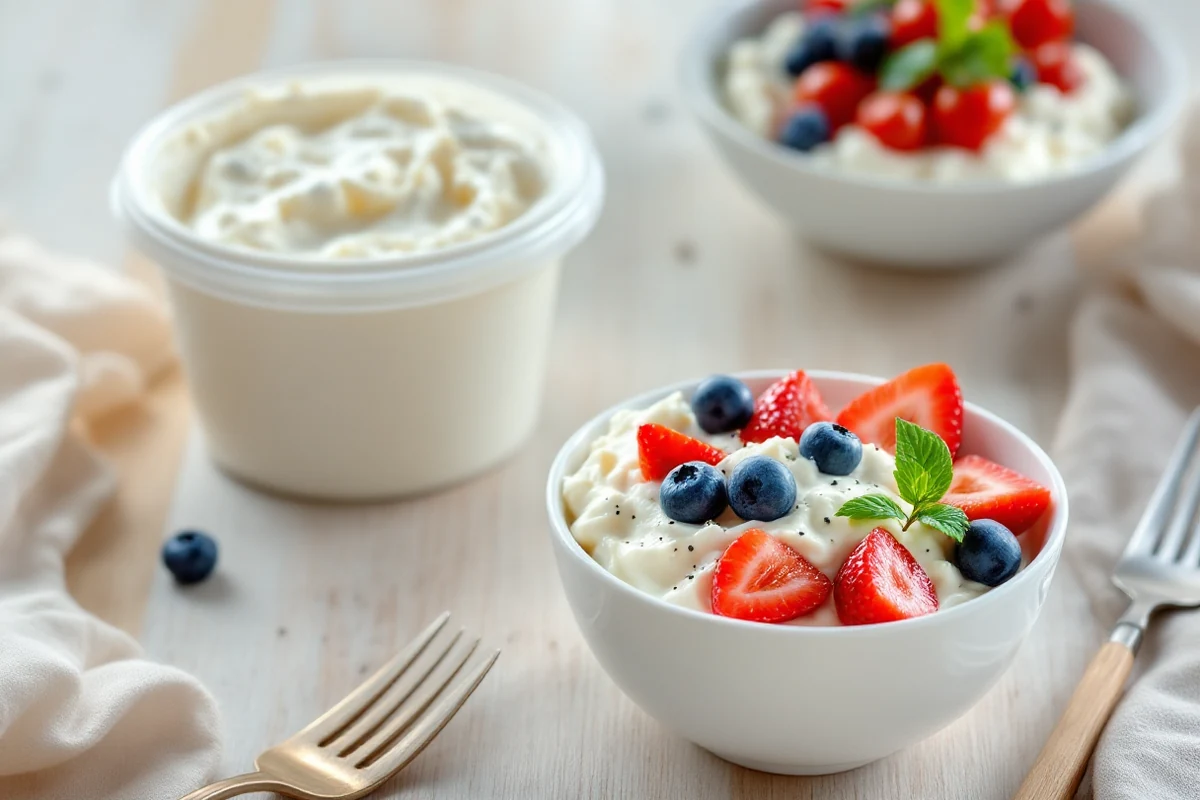
The question: “Is cottage cheese healthy, or is it just a bland 1970s food that came back because of social media?”
Cottage cheese went viral a couple of years ago: whipped, baked into flatbread, blended into ice cream. That makes a lot of people suspicious. When a food gets this popular this fast, it’s fair to ask is cottage cheese healthy, or is it mostly hype.
Verdict: Mostly true, with one real catch. Cottage cheese is a high-protein, fairly low-calorie food, and the research on cheese and dairy is neutral to modestly positive. The catch is sodium: it’s one of the saltier things in the dairy aisle.
Here’s what the numbers and the studies actually show.
Want high protein meals without the guesswork? Our free life-size Starter Pack is 5 printable mats you lay on the counter and fill, plus a weekly protein and fiber tracker.
What’s in cottage cheese (USDA numbers)
For 1 cup of low-fat (2%) cottage cheese, from USDA FoodData Central:
| Per 1 cup (226g) | Amount | % Daily Value |
|---|---|---|
| Calories | 183 | |
| Protein | 23.5g | 47% |
| Carbs | 11g | 4% |
| Sugars (milk sugar) | 9g | |
| Fat | 5g | 7% |
| Saturated fat | 2.8g | 14% |
| Calcium | 251mg | 19% |
| Sodium | 696mg | 30% |
| Fiber | 0g | 0% |
Two things jump out. Protein is high for the calories: about 13g of protein per 100 calories, which is more than eggs (about 9g) or cheddar (about 6g). And sodium is high: a cup has nearly a third of a day’s worth.
What the studies show about cottage cheese
There aren’t many studies on cottage cheese alone. Most research looks at “cheese” or “dairy” as a group, so I’ll be clear about which is which.
It’s as filling as eggs (2015)
A randomized crossover trial in 30 healthy adults compared two snacks with the same calories, protein and fat: an omelette and cottage cheese. Both kept people full for about the same time (close to 3 hours before they asked for lunch), and both led to the same lunch intake and hunger ratings. The cottage cheese was digested faster, but that didn’t change how full people felt. (PMID 25772196)
Cheese and heart health: neutral to modestly positive (2023)
A large umbrella review pooled meta-analyses of prospective studies on cheese and 47 health outcomes. Eating the most cheese, compared with the least, was linked to slightly lower risk of cardiovascular disease (about 8% lower), coronary heart disease and stroke, and a slightly lower risk of death from any cause. The authors rated the evidence as moderate quality and concluded cheese has “neutral to moderate benefits.” (PMID 37328108)
Dairy overall: small benefits, weak to suggestive evidence (2025)
Two newer reviews found the same direction. One umbrella review linked total dairy, milk and yogurt with slightly lower cardiovascular risk, and total and low-fat dairy with lower risk of high blood pressure, while rating most of the evidence “weak.” (PMID 40944114) A 2025 analysis of the UK and China biobanks plus a meta-analysis found total dairy linked to about 4% lower cardiovascular risk, with the clearest links for cheese and low-fat dairy. (PMID 39762253) An earlier meta-analysis also linked low-fat dairy with lower risk of high blood pressure. (PMID 33985895)
Cottage cheese at night won’t boost your metabolism (2018)
You’ll see claims that a bowl before bed “burns fat overnight.” A small randomized trial in 10 active women gave them cottage cheese (30g protein), a casein shake or a placebo before sleep. Next-morning resting metabolism and hunger were the same in all three groups. (PMID 30249314) Eating it at night is fine. It just isn’t magic.
Most people with lactose intolerance can handle it
Half a cup of 2% cottage cheese has about 4.5g of milk sugar (lactose). A review of tolerance studies found almost everyone with lactose intolerance can handle about 12g of lactose in one sitting. (PMID 26713460) So a normal serving is usually fine, though everyone’s tolerance differs, and lactose-free cottage cheese exists.
The real catch: sodium
This is the part social media skips. Salt is added during cottage cheese making, so a cup of 2% has about 696mg of sodium. Many people eat it two or three times a day once they get into it, and that adds up fast, especially with salty toppings like everything bagel seasoning, salsa or deli meat.
Why it matters: a Cochrane review of 34 trials found that cutting salt by about 4.4 grams a day lowered blood pressure by about 4 points systolic on average, with bigger drops in people who already had high blood pressure. (PMID 23558162)
What to do about it:
- Buy no-salt-added cottage cheese when you can find it. USDA lists it at about 30mg of sodium per cup instead of 696mg, and it has slightly more protein.
- Pair it with fruit or plain vegetables, not more salty foods.
- Count it if your doctor has asked you to limit sodium.
Why people doubt it
- It looks plain. Lumpy, white and mild, it reads as “health food you force down” rather than something good on its own.
- It’s old-fashioned. It was a staple of 1970s weight-watching plates, so many people file it under fads.
- The internet overcorrected. When a food goes viral, the claims get bigger than the evidence (“burns fat overnight”, “better than protein powder”). Some of the pushback is a reaction to that.
The truth is in the middle: it’s a useful, affordable protein food with one thing to watch.
The honest fine print
- Most studies are on cheese or dairy as a group, and they’re observational: they show links, not proof that cheese causes better health. Cottage cheese is a fresh, lower-fat cheese, so it may not behave exactly like the aged cheeses in those studies.
- The heart-health links are small, around 4 to 8% lower risk. That’s not a reason to eat a tub a day.
- The satiety and bedtime studies are small (30 and 10 people).
- It has no fiber and only modest vitamins compared with whole foods like beans or vegetables, so it works best as part of a meal, not the whole meal.
- If you have kidney disease, high blood pressure or a milk allergy, ask your doctor about how much is right for you.
Cottage cheese vs eggs vs Greek yogurt
Comparable portions, from USDA data:
| 2% cottage cheese, 3/4 cup | Nonfat Greek yogurt, 3/4 cup | 2 large eggs | |
|---|---|---|---|
| Calories | 138 | 104 | 143 |
| Protein | 17.7g | 17.5g | 12.6g |
| Sodium | 524mg | 61mg | 142mg |
| Calcium | 189mg | 189mg | 56mg |
Cottage cheese and Greek yogurt are almost tied on protein and calcium. Greek yogurt wins on sodium and calories, cottage cheese wins on savory uses. Eggs bring less protein per serving but very little sodium. All three are good choices. Rotating them is better than picking one forever.
How to eat cottage cheese the healthy way
- Pair it with fiber: berries, peaches, tomatoes, cucumber, beans or whole grains.
- Choose no-salt-added or low-sodium tubs for everyday use.
- Watch the toppings: a drizzle of honey is fine, a cup of granola changes the picture.
- Use it as a swap: in place of mayo in egg salad, sour cream on potatoes or ricotta in lasagna. Don’t like the texture? Here’s how to eat cottage cheese even if you hate it.
Ideas to start with: our cottage cheese bowl recipes, cottage cheese breakfast recipes and cottage cheese lunch ideas. You can also make homemade cottage cheese and salt it as lightly as you want. Or browse all 35 healthy cottage cheese recipes.
FAQ
Is cottage cheese healthy?
Mostly yes. It’s high in protein for its calories and a good source of calcium, and studies on cheese and dairy are neutral to modestly positive. The main downside is sodium: about 700mg per cup of regular cottage cheese.
Is there a downside to eating cottage cheese?
The main one is sodium. It also has no fiber, and some people with lactose intolerance or a milk allergy can’t eat it comfortably.
Is it okay to eat cottage cheese every day?
For most healthy people, a serving a day fits well, especially with fruit or vegetables. If you eat it several times a day, choose a no-salt-added tub to keep sodium in check.
Is cottage cheese better for you than eggs?
Neither is better overall. Cottage cheese has more protein per serving and more calcium; eggs have much less sodium. In one study, they were equally filling.
What is better for you, cottage cheese or yogurt?
Plain Greek yogurt and cottage cheese have about the same protein. Greek yogurt has far less sodium and fewer calories. Cottage cheese works better in savory dishes. Both are good choices.
So, is cottage cheese healthy?
Is cottage cheese healthy? Mostly yes: lots of protein for the calories, useful calcium, and research on cheese and dairy that leans neutral to slightly positive. The real catch is sodium, so buy no-salt-added when you can and pair it with fruit and vegetables.
Sources
- Marsset-Baglieri A et al. The satiating effects of eggs or cottage cheese are similar in healthy subjects despite differences in postprandial kinetics. Appetite. 2015. PMID 25772196.
- Leyh SM et al. Pre-sleep protein in casein supplement or whole-food form has no impact on resting energy expenditure or hunger in women. Br J Nutr. 2018. PMID 30249314.
- Zhang M et al. Cheese consumption and multiple health outcomes: an umbrella review and updated meta-analysis of prospective studies. Adv Nutr. 2023. PMID 37328108.
- Sharifan P et al. Dairy consumption and risk of cardiovascular and bone health outcomes in adults: an umbrella review and updated meta-analyses. Nutrients. 2025. PMID 40944114.
- Zhuang P et al. A global analysis of dairy consumption and incident cardiovascular disease. Nat Commun. 2025. PMID 39762253.
- Heidari Z et al. Dairy products consumption and the risk of hypertension in adults: an updated systematic review and dose-response meta-analysis of prospective cohort studies. Nutr Metab Cardiovasc Dis. 2021. PMID 33985895.
- He FJ, Li J, MacGregor GA. Effect of longer term modest salt reduction on blood pressure: Cochrane systematic review and meta-analysis of randomised trials. BMJ. 2013. PMID 23558162.
- Corgneau M et al. Recent advances on lactose intolerance: tolerance thresholds and currently available answers. Crit Rev Food Sci Nutr. 2017. PMID 26713460.

Get the free life-size Starter Pack. 5 printable mats (4 meals + a snack) plus a weekly protein and fiber tracker. Lay a mat on the counter and match each ingredient to its shape, no measuring cups.



Leave a Reply