

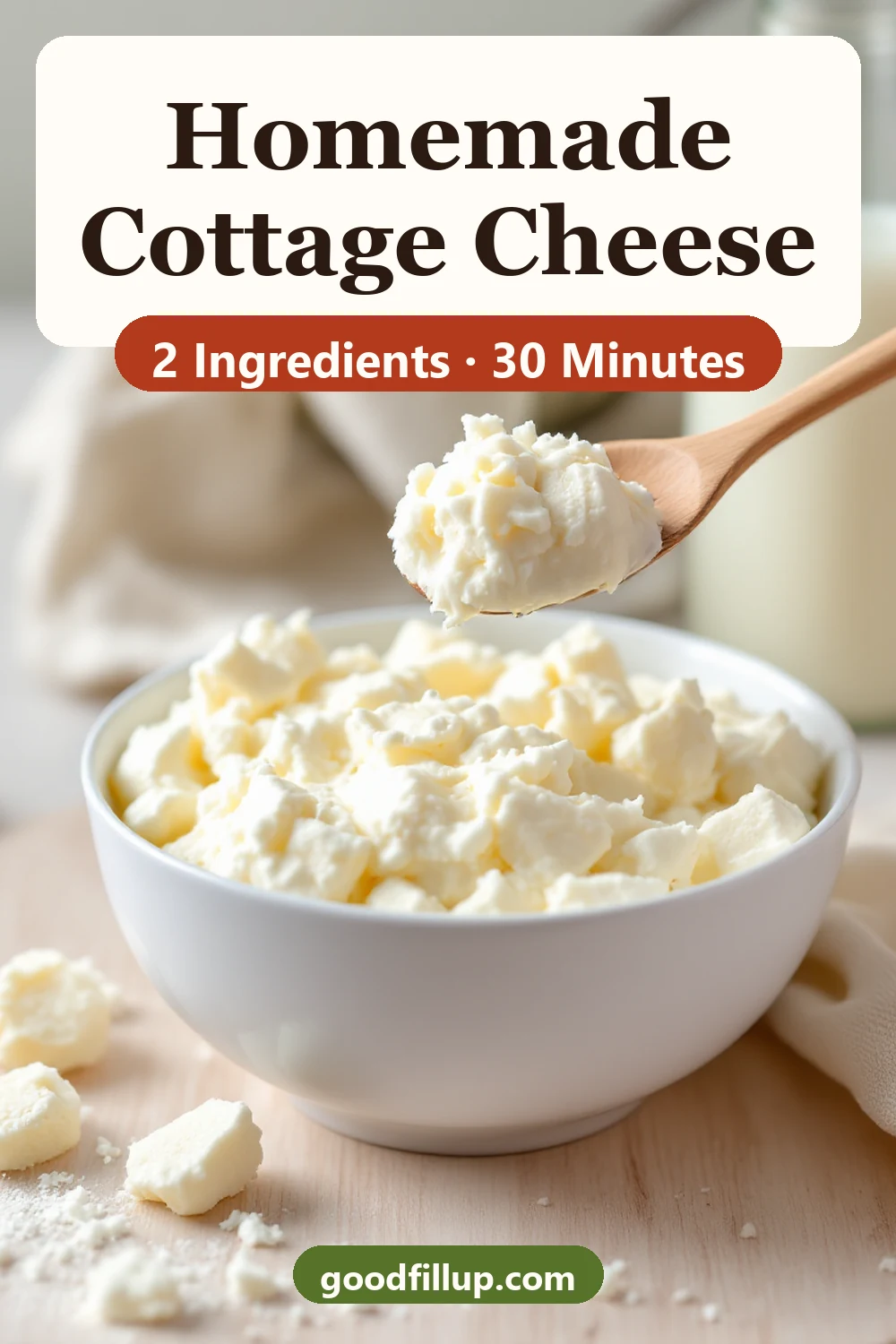
Homemade cottage cheese takes two ingredients you probably have right now: milk and white vinegar. Heat the milk, stir in the vinegar, and within minutes it separates into soft white curds and thin yellow whey. Drain, rinse, salt, add a splash of milk, and you have a bowl of fresh cottage cheese that tastes milder and creamier than most store tubs.
It takes about 30 minutes, most of it hands-off, and a half gallon of milk makes about 2 cups.
Want meals you can build without measuring? Grab our free life-size Starter Pack: 5 printable mats you lay on the counter and fill, no measuring cups.
I first made it on a Sunday when every recipe on my list needed cottage cheese and the store was closed. I expected a science experiment. What I got was the freshest cottage cheese I’d ever tasted, and a jar of whey I used in pancakes the next morning.
What you need
Ingredients (makes about 2 cups, 4 servings):
- 8 cups (half gallon) fat-free (skim) milk, pasteurized but not ultra-pasteurized
- 1/2 cup (120ml) white vinegar (or fresh lemon juice)
- 1/2 tsp salt
- 1/4 cup milk or half-and-half, to dress the curds
Equipment:
- A large heavy pot
- A kitchen thermometer (helpful, not required)
- A fine sieve or colander lined with cheesecloth or a thin kitchen towel
Why skim milk? It gives the firmest curds and lands closest to store-bought low-fat cottage cheese. Whole milk works too and makes softer, richer curds, but it’s higher in fat and calories than the numbers below.
How to make homemade cottage cheese
- Heat the milk. Pour the milk into the pot and warm it over medium heat, stirring now and then so it doesn’t scorch, until it reaches 185°F (85°C). No thermometer? Stop when it’s steaming with tiny bubbles around the edge, just before a simmer.
- Add the vinegar. Take the pot off the heat and slowly pour in the vinegar while stirring gently for about 30 seconds. You’ll see curds form right away.
- Rest 10 minutes. Leave it alone. The curds firm up and the liquid turns clear and yellow-green. That’s the whey.
- Drain. Pour everything through the cloth-lined sieve. Keep the whey if you want to use it (see below).
- Rinse. Run cold water over the curds in the cloth for about 30 seconds, gently breaking them up with your fingers. This cools them, stops them from getting tough and washes away the vinegar taste.
- Squeeze. Gather the cloth and squeeze out as much water as you can. The drier the curds, the better they hold the dressing.
- Salt and dress. Move the curds to a bowl, break them into small pieces, stir in the salt and the 1/4 cup of milk or half-and-half. Taste and add more milk for a creamier style.
- Chill. It tastes best after 30 minutes in the fridge.
Tips for soft, not rubbery, curds
- Don’t boil the milk. Above about 195°F the curds turn small and tough.
- Skip ultra-pasteurized milk. It’s heated so high that it often won’t form proper curds. Check the label; regular pasteurized milk works best.
- Stir gently after adding the vinegar. Hard stirring breaks the curds into grains.
- Rinse with cold water. It’s the step people skip, and it’s the difference between rubbery and tender curds.
- Want bigger curds? Use whole milk, add the vinegar a little more slowly and don’t stir after the first 30 seconds.
Homemade cottage cheese recipes: how to use it
Use it anywhere you’d use store-bought cottage cheese:
- Blend it with a pinch of salt and lemon for whipped cottage cheese, great on toast or as a dip.
- Bake it into 2-ingredient cottage cheese bagels.
- Eat it with fruit: peaches, pineapple or berries and a drizzle of honey.
- Go savory: cucumber, cherry tomatoes, black pepper and olive oil.
- Cook with it: stir it into scrambled eggs, pasta sauce or lasagna.
What to do with the whey
A half gallon of milk gives you about 6 cups of whey. Don’t pour it out:
- Use it in place of water or milk in pancakes, muffins, bread dough or oatmeal.
- Blend it into smoothies.
- Cook rice or pasta in it.
- Water your plants, diluted 1:1 with water (it’s acidic, so not for every plant).
It keeps about 5 days in a covered jar in the fridge.
Homemade vs store-bought: the honest numbers
We can’t lab-test a homemade batch, so here’s how we estimated. Skim milk curds made with vinegar are close to what USDA lists as dry curd cottage cheese (made from skim milk). Using that, plus the milk and salt you add, one 1/2-cup serving of this recipe has about:
| Per 1/2 cup | Homemade (this recipe, estimated) | Store-bought 2% cottage cheese |
|---|---|---|
| Calories | about 72 | 92 |
| Protein | about 10g | 12g |
| Fat | under 1g | 2.6g |
| Sodium | about 300mg (you control it) | 348mg |
Store figures are from USDA FoodData Central. The half gallon of skim milk starts with about 66g of protein; roughly 40g ends up in the curds, and the rest stays in the whey (which is why it’s worth using).
The biggest advantage of homemade is control: you choose the milk, the salt and how creamy to make it. It’s not cheaper than the cheapest store tub in most places, but it’s fresher and there are no stabilizers or gums.
Storage
Keep it in a covered container in the fridge and eat it within 5 days. If it dries out, stir in a spoonful of milk. Don’t freeze it; the texture turns grainy.
FAQ
How do I make homemade cottage cheese?
Heat milk to 185°F, stir in white vinegar off the heat, rest 10 minutes, drain the curds in a cloth, rinse with cold water, squeeze dry, then add salt and a little milk or cream.
Can I use lemon juice instead of vinegar?
Yes, use the same amount of fresh lemon juice. It gives a slightly lemony flavor, which is nice with fruit.
Why didn’t my milk curdle?
Most often it’s ultra-pasteurized milk, or the milk wasn’t hot enough. Heat it to 185°F, or add another tablespoon of vinegar and wait a few minutes.
Is homemade cottage cheese the same as ricotta or paneer?
Close cousins. All three are made by curdling hot milk with acid. Ricotta is usually softer and made with whole milk; paneer is pressed into a firm block. Cottage cheese is rinsed curds dressed with a little milk.
Is homemade cottage cheese healthy?
It’s a simple, high protein food made from milk, vinegar and salt. Made with skim milk it’s low in fat, and you decide how much salt goes in. For more on what’s in a tub, see our cottage cheese breakfast recipes for ways to eat it every day.
The short version
Heat 8 cups of skim milk to 185°F, stir in 1/2 cup white vinegar off the heat, rest 10 minutes, drain, rinse the curds with cold water, squeeze, then stir in salt and a splash of milk. Homemade cottage cheese in 30 minutes, about 2 cups. Wondering whether it’s good for you? Read our myth buster: is cottage cheese healthy?
Get the free life-size Starter Pack. 5 printable mats with 15 to 37g protein each: print, lay it on the counter and match each ingredient to its shape. No measuring cups.

Homemade Cottage Cheese
Ingredients
Method
- Heat the milk in a large heavy pot over medium heat, stirring often, to 185°F (85°C), just before a simmer.
- Take the pot off the heat and slowly stir in the vinegar for about 30 seconds.
- Rest 10 minutes until curds form and the whey turns clear and yellow-green.
- Pour through a sieve lined with cheesecloth or a thin kitchen towel.
- Rinse the curds with cold water for 30 seconds, breaking them up gently.
- Squeeze out as much water as you can.
- Stir in the salt and the milk or half-and-half. Chill 30 minutes.





Leave a Reply