


The myth: “Your body can only use about 30 grams of protein per meal. Anything more is wasted.”
You’ve probably heard it at the gym, on social media or from a friend splitting a chicken breast in half “so it doesn’t go to waste.” It sounds scientific. It also shapes how a lot of people eat: tiny portions of protein at every meal, or a nervous feeling about a big steak dinner.
The verdict: Mostly a myth. There’s no hard cap of 30g of protein per meal. Your body absorbs all the protein you eat, and newer studies show that eating more than 25 to 30 grams in one meal still adds to muscle building, just with smaller returns. There’s a grain of truth in it, though: spreading protein across your meals seems to work better than eating it all at dinner.
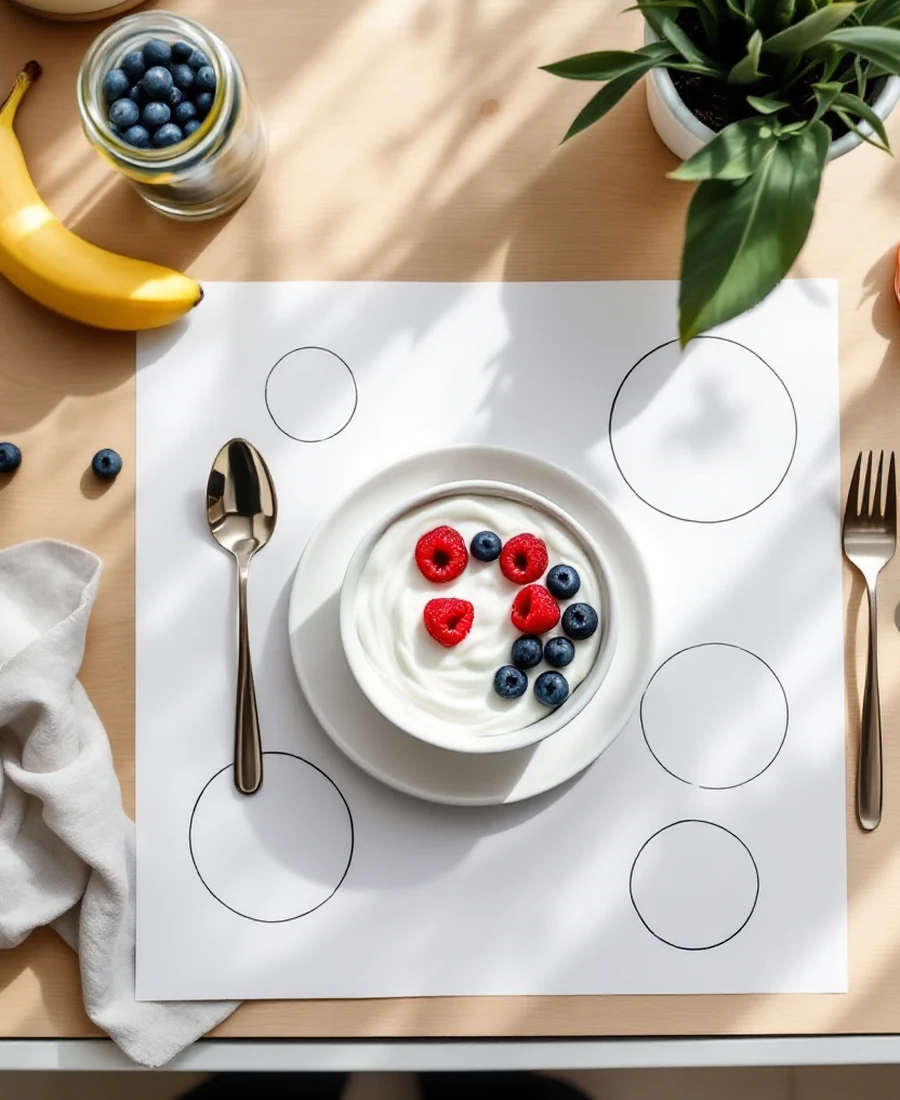
Want an easy 30g protein breakfast? Our free life-size Starter Pack has 5 printable mats with 15 to 37g protein each. Lay them on the counter and match the shapes.
What the studies show about 30g of protein per meal
The study that started the “20 to 30g” idea (2009)
In a study of young men after a leg workout, muscle protein synthesis (the process that builds and repairs muscle) went up as the protein dose went up, then leveled off at about 20 grams of egg protein. At 40 grams, more of the extra amino acids were burned for energy (Moore et al., 2009, PMID 19056590).
That’s where the “your body can only use 20 to 30 grams” idea comes from. But notice the details: it measured only muscle-building, only for 4 hours, only after a leg workout, and only with a fast-digesting protein drink.
40g beat 20g after a full-body workout (2016)
When trained young men did a whole-body workout instead of legs only, 40 grams of whey led to about 20% more muscle protein synthesis than 20 grams (Macnaughton et al., 2016, PMID 27511985). More muscle worked seems to mean more protein put to use.
100g beat 25g, and the effect lasted over 12 hours (2023)
The most striking study so far gave people 25 grams or 100 grams of protein after exercise and tracked what happened to it with several tracers. The 100-gram meal caused a bigger and longer anabolic response, lasting more than 12 hours, and only a small amount of the extra protein was burned for energy (Trommelen et al., 2023, PMID 38118410). The authors’ conclusion: the response to protein “has no upper limit in magnitude and duration” that they could find.
A review put it into practice (2018)
A review of the research concluded that while bigger doses do lead to more amino acids being burned, not all of the extra is wasted: some is still used for building tissue. The authors suggested aiming for about 0.4 g of protein per kg of body weight per meal, across at least four meals if muscle is the goal (Schoenfeld and Aragon, 2018, PMID 29497353). For a 150-pound (68 kg) person, that’s about 27 grams per meal.
The grain of truth: spreading it out helps
Two studies suggest how you split your protein matters, even if there’s no hard cap:
- When adults ate about 30 grams at each of breakfast, lunch and dinner, their 24-hour muscle protein synthesis was 25% higher than when they ate the same total protein skewed to dinner (about 11g at breakfast, 16g at lunch, 63g at dinner) (Mamerow et al., 2014, PMID 24477298).
- After exercise, 20 grams every 3 hours beat both 10 grams every 1.5 hours and 40 grams every 6 hours over 12 hours of recovery (Areta et al., 2013, PMID 23459753).
The takeaway isn’t “never eat more than 30 grams.” It’s “don’t save all your protein for dinner.” Many people eat a light, carb-heavy breakfast and a big protein dinner, which is exactly the skewed pattern from the Mamerow study.
Why people believe the myth
- The early studies were real. The 2009 study did find a plateau at 20 grams, for that setting.
- “Wasted” sounds logical. If protein is burned for energy, it feels wasted, but your body uses it as fuel like any other food.
- It’s easy to remember. “30 grams per meal” is a simple rule, and simple rules spread fast.
- Supplement scoops are about 25 to 30 grams, which makes the number feel official.
The honest fine print
- Most of these studies are small, often a few dozen people or fewer, and mostly young men who lift weights. Results may differ for women, older adults and people who don’t exercise.
- Muscle building isn’t the only job of protein. It also supports enzymes, hormones, your immune system and more. Absorption isn’t the question: you absorb nearly all the protein you eat.
- Older adults may need larger servings, not smaller ones, to get the same muscle response. That’s still being studied.
- If you have kidney disease or another medical condition, ask your doctor how much protein is right for you.
- Total daily protein matters most. Getting enough over the day beats worrying about the exact number at each meal.
What 30g of protein looks like
Since most breakfasts fall far short, here’s what a 30g meal looks like. Numbers from USDA FoodData Central:
| Food | Amount | Protein |
|---|---|---|
| Chicken breast, roasted | 4 oz (113g) | 35g |
| Salmon, cooked | 5 oz (142g) | 31g |
| Firm tofu | 180g | 31g |
| Greek yogurt + skim milk | 1 cup each | 32g |
| 93% lean ground beef, cooked | 4 oz | 30g |
| Lentils, cooked | 1 1/2 cups | 27g |
| Cottage cheese | 1 cup | 23g |
| Eggs | 3 large | 19g |
Notice that three eggs alone don’t get there. Add 1/2 cup cottage cheese and you’re at about 31g.
30g protein breakfasts (with full recipes)
- High protein overnight oats: 33g, no powder
- High protein yogurt bowl: 32g
- High protein breakfast casserole: 32g
- Breakfast burritos: 31g
- Cottage cheese protein pancakes: 30g
- Coffee protein smoothie: 35g
More in our 25 easy high protein breakfast ideas.
FAQ
Can your body absorb more than 30 grams of protein at once?
Yes. Your gut absorbs nearly all the protein you eat. The real question is how much goes to building muscle, and studies show doses above 30g still add some benefit.
What does 30 grams of protein in a meal look like?
About 4 oz of chicken breast, 5 oz of salmon, 180g of firm tofu, or a cup of Greek yogurt with a cup of milk.
How can I get 30 grams of protein at breakfast?
Combine two protein foods: eggs plus cottage cheese, Greek yogurt plus milk, or overnight oats made with Greek yogurt. Our 30g breakfasts above are good starting points.
Is it bad to eat 50 grams of protein in one meal?
For healthy people, studies don’t show harm, and some of the extra still supports muscle. Spreading protein across meals may work a bit better, so a bigger breakfast and a smaller dinner is a good balance.
How much protein do I need per day?
The RDA for adults is 0.8 g per kg of body weight (about 55g for a 150-pound person), a minimum to prevent deficiency. Active people and older adults often benefit from more. Ask a registered dietitian for a personal number.
The short version
The “30 grams per meal” limit is mostly a myth. You absorb all your protein, and bigger servings still help build muscle, just with smaller gains. The useful part of the idea: spread your protein across the day instead of eating most of it at dinner. Starting with a 30g breakfast is the easiest fix.
Sources
- Moore DR et al. Ingested protein dose response of muscle and albumin protein synthesis after resistance exercise in young men. Am J Clin Nutr. 2009. PMID 19056590.
- Areta JL et al. Timing and distribution of protein ingestion during prolonged recovery from resistance exercise alters myofibrillar protein synthesis. J Physiol. 2013. PMID 23459753.
- Mamerow MM et al. Dietary protein distribution positively influences 24-h muscle protein synthesis in healthy adults. J Nutr. 2014. PMID 24477298.
- Macnaughton LS et al. The response of muscle protein synthesis following whole-body resistance exercise is greater following 40 g than 20 g of ingested whey protein. Physiol Rep. 2016. PMID 27511985.
- Schoenfeld BJ, Aragon AA. How much protein can the body use in a single meal for muscle-building? J Int Soc Sports Nutr. 2018. PMID 29497353.
- Trommelen J et al. The anabolic response to protein ingestion during recovery from exercise has no upper limit in magnitude and duration in vivo in humans. Cell Rep Med. 2023. PMID 38118410.

Get the free life-size Starter Pack. 5 printable mats with 15 to 37g protein each: print, lay it on the counter and match each ingredient to its shape. No measuring cups.

Leave a Reply